Healing Music Enterprises Blog

Tune Your Life with Music

Healing Music Enterprises Blog header image 1

Dr. Alfred Tomatis and Mozart

December 7th, 2008 · The Mozart Effect...why Mozart?

→ 1 CommentTags: ·

Music Power, and the Brain

December 4th, 2008 · Music and the Brain

Music Power, and the Brain

A man named Laurence O’Donnell has written a fascinating paper. and subsuquently a website called “Music Power.” I highly recommend that you check out both. He writes a lot about music and the brain. One thing he says is “Responses to music are easy to be detected in the human body. Classical music from the baroque period causes the heart beat and pulse rate to relax to the beat of the music. As the body becomes relaxed and alert, the mind is able to concentrate more easily. Furthermore, baroque music decreases blood pressure and enhances the ability to learn. Music affects the amplitude and frequency of brain waves, which can be measured by an electro-encephalogram. Music also affects breathing rate and electrical resistance of the skin. It has been observed to cause the pupils to dilate, increase blood pressure, and increase the heart rate. ” Check it out! It’s full of information that I think you’ll enjoy!

→ No CommentsTags:

Please participate in my Music for Surgery Research

December 2nd, 2008 · Music and Surgery

Particpate in my Music with Surgery research!

Imagine that you have just been told that you must have surgery. What are your feelings? Fear, apprehension, anxiety, even terror?? Everyday around the world, people are told that they must have surgery for cancer, joint replacement, heart problems, organ transplants. And then there are those who sign up for elective surgery, people who want to look younger and more beautiful!
You probably know that recently I received a U.S. Patent on my special unique headphones created for before, during and after surgery. For a very limited time, I am offering a free download of the music for anyone who is having surgery in return for answersing some questions before and after surgery. I will even call you before and after to ask you these questions myself! This offer will be good until I have received 100 sets of data which could take as little as a week, but no more than a month, hopefully. If you (or friend or family member) are interested in participating in this, contact me immediately through the blog or the website or at chantdoc@gmail.com.
Thank you and hope to hear from you soon!

→ No CommentsTags:

Would you like to be part of my research?

November 29th, 2008 · Music and Surgery

All over the world, at any given moment, people are being told that they need to have surgery:  back surgery, shoulder surgery, knee replacements, hip replacements, hysterectomies…you get the picture.  For almost 20 years I have been assisting people who are having surgery to find the perfect music for them.  Now I have created my surgical serenity headphones and downloads so that anyone can use music with their surgery at any time!

Now I need to gather some data specific to my surgical serenity music that I have chosen for my first-time-ever downloads of music for surgery.  I need to get not only data, but testimonials!  If YOU or someone you know is planning to have surgery, please let me know and I will send them a free download in exchange for some basic information about their before and after subjective experience of the procedure and a sentence or two about the experience. 

I will offer this special, time-limited opportunity until I have gathered at least 100 testimonials.  Get your requests in NOW! 

Sincerely,

Alice H. Cash, Ph.D., LCSW

→ No CommentsTags:

How does music help a sick baby or preemie?

November 20th, 2008 · Music Healing, Music with Newborns and Preemies

Gigi and Beau.9.14

Music soothes a sick baby or preemie

How does music help a sick preemie or baby?

  • When your infant is sick, you’ll do anything to turn the tide, right? Music therapy has been around for literally thousands of years, but most people don’t realize how powerfully healing music can be. With a preemie or newborn full-term infant, there are many benefits.
  • When a baby is sick, you must stabilize the heart-beat: music with a slow, soft, steady pulse can do that. Our bodies automatically synchronize with the pulse of music!
  • When a baby is sick, s/he needs to hear a soft, comforting, preferably familiar voice. A mother or other singing lullabies, can calm a frightened and agitated newborn.
  • When a baby is underweight and needs to take in nourishment, soft lullabies playing can help a baby calm down enough to take in the nourishment s/he desperately needs.

A crying infant seriously disturbs not only the sleep of the entire family, but also the mental health.  As a therapist, I’ve had many people tell me that they are emotionally exhausted and drained after a hard night of walking the floors with a colicky baby.  The CD of lullabies that I created is intended to familiarize the mother and entire family with classic lullaby melodies.  If you play this in your home or car before baby arrives, you’ll learn these tunes and they’ll be safely stored in your brain!  When you get home from hospital with infant and he begins to cry, you can begin softly crooning these lullabies and, believe or not, baby will recognize them from all the times you played them before he was born.

Many people do not realize that the unborn baby can hear almost everything the mother hears from the 4th month forward!  This means that the sonic environment should be soothing, comforting and not loud or raucous in any way.

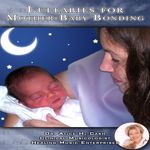
I have created a lullaby CD/download just for you and your baby. Click on the image of the mother and baby at the side of the blog to purchase. Let me know how I can help you!

Can’t sleep because of crying baby? Click Here!

→ No CommentsTags: ·

Will YOU use music with your surgery?

November 18th, 2008 · Music and Surgery

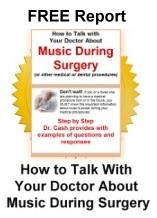
PA160681-150x150You know that music makes a difference in your surgical procedure, right? You can have live music but that’s a little harder that purchasing either the special music I’ve put together for you or my pre-programmed MP3 player, ready to go into surgery with you. Which do you want? Click on the ad in the top left corner to order!  Here are nine important questions to ask your surgeon before your surgery.  Preparing for surgery can be a big undertaking. However, in the midst of your preparation don’t forget to get all your questions answered before the surgery. Write down questions  and ask your primary care doctor or surgeon. Don’t be afraid to ask what you think is a silly question. To help you prepare for surgery, here are nine questions to get you started. Ask these questions before your surgery, as well as any others that come to mind.

1. What is done during the surgery? Ask for a clear description of the operation. If necessary, ask the doctor to draw a picture to help explain exactly what the surgery involves. Find out if there are alternative surgical procedures. Are there alternatives to surgery? Sometimes surgery is the only way to correct the problem. But one option might be watchful waiting, to see if the problem gets better or worse. 2. How will surgery help? A hip replacement, for example, may mean you’ll be able to walk comfortably again. To what extent will the surgery help, and how long will the benefits last? You’ll want realistic expectations.

3. What are the risks? All operations carry some risk. Weigh the benefits against the risks. Ask about the side effects of the operation, such as the degree of pain you might expect and how long that pain will last.

4. What kind of experience have you had with this surgery? How many times has the doctor performed this surgery, and what percentage of the people who have had the surgery had successful results? To reduce your risks, you want a doctor who is thoroughly trained in the surgery and who has plenty of experience doing it.

5. Where will the surgery be done? Many surgeries today are done on an outpatient basis. You go to a hospital or a clinic for the surgery and return home the same day.

6. Will I be put to sleep for the surgery? Your surgery may require only local anesthesia, which means that just part of your body is numbed for a short time. In case of general anesthesia, you are put to sleep.

7. How long will the surgery and recovery take? Many surgeries can be done relatively quickly and don’t require an extended stay in a hospital. However, it may be different for your surgery, so you should ask. Also ask whether you’ll need to stay overnight in the hospital, or perhaps stay several days. You’ll want to know when most people are able to resume their normal activities, such as doing chores around the house and returning to work. You may think there would be no harm in lifting a sack of groceries after a week or two. But there might be. Follow your doctor’s advice as carefully as possible. Also ask your surgeon if you’ll have any restrictions on what you can eat or drink before or after the surgery.

8. What will it cost me? Health insurance coverage varies. You may not have to pay anything. You might have a deductible to meet. Or perhaps you’ll have to pay a percentage of the cost. The doctor’s office can usually give you information about this, but you also need to check with your insurance company. Be aware there will be both a surgeon’s fee and a hospital or facility fee — know the cost of both. Be certain to know if you are responsible for a flat copay — a set amount for the surgery — or if you have to pay a percentage of the bill. There’s a big difference.

9. Should I get a second opinion? If, after asking all these questions and others, you still have unanswered questions, are unsatisfied with the answers or are still uncomfortable about surgery, you may want to consider the advice of another doctor. A second opinion, also called a consultation, can be a good way for you to get some more perspective on your surgical options. If you seek a second opinion, do so with someone with expertise doing the surgery. Your primary care doctor may be able to help suggest someone for a second opinion. Keep in mind that a second opinion isn’t necessarily any better than the first one. If there’s disagreement, or agreement, between the two opinions, it’s still up to you to evaluate what choice you feel most comfortable with.

→ No CommentsTags:

Music and Epilepsy: Is there a Connection?

November 16th, 2008 · Music and the Brain

Music and Epilepsy

Using the sound of her violin, concert violinist Martha Curtis teaches hope, and the power to overcome anything. Curtis has suffered from epilepsy her entire life, even having seizures on the biggest concert stages in the world.
15 years ago, Curtis put her career and love for music on the line, undergoing three major brain surgeries removing the part of the brain causing her seizures. Curtis was the first professional musician to undergo the procedure that has reportedly caused blindness, and losing the ability to hear music. A day after her third surgery, Curtis again played the violin, playing an excerpt from beethoven. The surgery was a success. Curtis has not suffered a seizure ever since, and now travels around the world talking to people from all walks of life, teaching them never to give up.
Martha Curtis’ story has been featured on CBS’s 60 minutes, and she is currently writing a book. Curtis credits music for saving her life, allowing beauty into her heart, not just an illness.

→ No CommentsTags:

Research on Mozart vs. New Age music

November 13th, 2008 · The Mozart Effect...why Mozart?

Interesting Mozart Research

Mozart versus new age music: relaxation states, stress, and ABC relaxation theory.Smith JC, Joyce CA.Roosevelt University Stress Institute, Roosevelt University, Chicago, IL 60605, USA. jsmith@roosevelt.edu
benefits of Suzuki

Mozart vs. New Age

Smith’s (2001) Attentional Behavioral Cognitive (ABC) relaxation theory proposes that all approaches to relaxation (including music) have the potential for evoking one or more of 15 factor-analytically derived relaxation states, or “R-States” (Sleepiness, Disengagement, Rested / Refreshed, Energized, Physical Relaxation, At Ease/Peace, Joy, Mental Quiet, Childlike Innocence, Thankfulness and Love, Mystery, Awe and Wonder, Prayerfulness, Timeless/Boundless/Infinite, and Aware). The present study investigated R-States and stress symptom-patterns associated with listening to Mozart versus New Age music. Students (N = 63) were divided into three relaxation groups based on previously determined preferences. Fourteen listened to a 28-minute tape recording of Mozart’s Eine Kleine Nachtmusik and 14 listened to a 28-minute tape of Steven Halpern’s New Age Serenity Suite. Others (n = 35) did not want music and instead chose a set of popular recreational magazines. Participants engaged in their relaxation activity at home for three consecutive days for 28 minutes a session. Before and after each session, each person completed the Smith Relaxation States Inventory (Smith, 2001), a comprehensive questionnaire tapping 15 R-States as well as the stress states of somatic stress, worry, and negative emotion. Results revealed no differences at Session 1. At Session 2, those who listened to Mozart reported higher levels of At Ease/Peace and lower levels of Negative Emotion. Pronounced differences emerged at Session 3. Mozart listeners uniquely reported substantially higher levels of Mental Quiet, Awe and Wonder, and Mystery. Mozart listeners reported higher levels, and New Age listeners slightly elevated levels, of At Ease/Peace and Rested/Refreshed. Both Mozart and New Age listeners reported higher levels of Thankfulness and Love. In summary, those who listened to Mozart’s Eine Kleine Nachtmusik reported more psychological relaxation and less stress than either those who listened to New Age music or read popular recreational magazines. Results suggest the usefulness of ABC relaxation theory in comparing the different effects of music and relaxation techniques.

→ 2 CommentsTags: